

This is a use case about how a centralized, algo-powered connectivity platform can slash FIX infrastructure costs, accelerate market access & client onboarding, and enable consistent low-latency trading.
This post is for the leaders who build the foundation that makes modern trading possible: the CTOs, Heads of Infrastructure, and IT Managers.
Example Use Cases: Optimizing Market Connectivity
Use Case 1: Cost-Effective Smart Order Routing
- Scenario: A trading firm relies on several different brokers to execute its trades. Each broker is distinct, with its own commission structure. Additionally, a broker might specialize in certain types of trade executions or provide a superior performance advantage for specific order complexity profiles. To operate in a cost-effective manner, the firm’s connectivity layer must be intelligent enough to determine which broker is best suited for particular order profiles.
- The Challenge: Traders must manually decide which broker to use for every single order, or rely on static pre-determined routing paths. This process is slow, inconsistent, and prone to human error, leading to higher trading costs as opportunities are being missed. The alternative is building and maintaining complex, hard-coded routing logic for each trading application whilst performing scheduled periodic reconfiguration, which is expensive and inflexible.
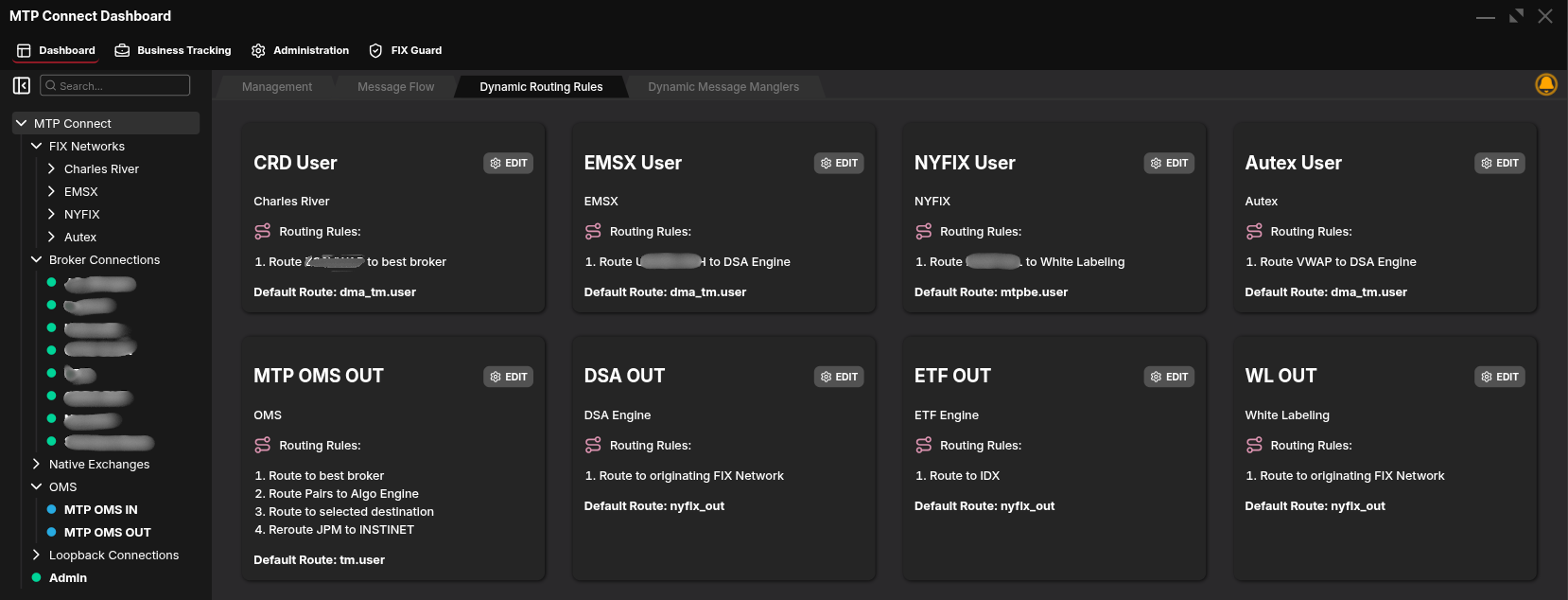
- The Solution: You use the platform’s embedded algo engine to create dynamic, smart routing rules. With a simple, code-based rule in our connectivity hub (MTP Connect), you can define that all orders with certain conditions and profiles are automatically routed to Broker A, while all others go to Broker B. This logic is centralized, easily managed, and ensures you are always using the most cost-effective route for every trade, automatically.
Use Case 2: Rapid Market Expansion
- Scenario: A European asset manager wants to start trading on a new exchange in Hong Kong, including digital assets, and has no broker relationship to cater for this.
- The Challenge: This is a daunting, multi-month IT project requiring new infrastructure, relationship building, custom development to handle new exchange protocols, and separate integrations for digital asset gateways.
- The Solution: A platform with full Protocol adaptability and existing integrations with global brokers and exchanges should be used. Our Connectivity hub (MTP Connect), for example, has this functionality pre-built. For your team, “entering the new market” becomes as simple as a configuration change. You can go live in days, not months.
Use Case 3: Slashing Infrastructure Costs
- Scenario: A firm has multiple trading teams, each using different strategies that require unique, intelligent order handling, such as Sophisticated DMA (SDMA) flows.
- The Challenge: Building and maintaining separate, intelligent routing and automation for each team is inefficient and costly. It leads to a complex web of redundant logic and spiraling infrastructure costs.
- The Solution: All connections are consolidated into a single platform that has a powerful, embedded algo engine. This centralizes the intelligent routing logic. With our connectivity hub, you can manage script-based routing rules and throttle messages per destination from a single dashboard, eliminating redundant systems and slashing costs.
Use Case 4: Ensuring Zero-Downtime Trading
- Scenario: A trading firm’s primary connection to a major exchange goes down during a critical market event.
- The Challenge: Trading stops. Orders are stuck. The firm is blind to the market and exposed to massive risk until the connection is manually restored.
- The Solution: The platform’s Dynamic Routing capabilities automatically detect the outage. User-defined, code-based rules instantly re-route order flow through a pre-configured backup connection, ensuring zero downtime for the trading desk.
Best Practices or Tips: SME Commentary
The Engineering Philosophy Behind Superior Connectivity
On the surface, a connectivity hub can be mistaken for simple plumbing—a set of pipes that moves data from point A to point B. However, in the world of high-frequency and algorithmic trading, the architecture of that “plumbing” is a critical differentiator that can make or break a trading strategy.
We asked our Tech Lead, Emina Ostojic, to share her perspective on what truly makes a connectivity platform superior from an engineering standpoint.
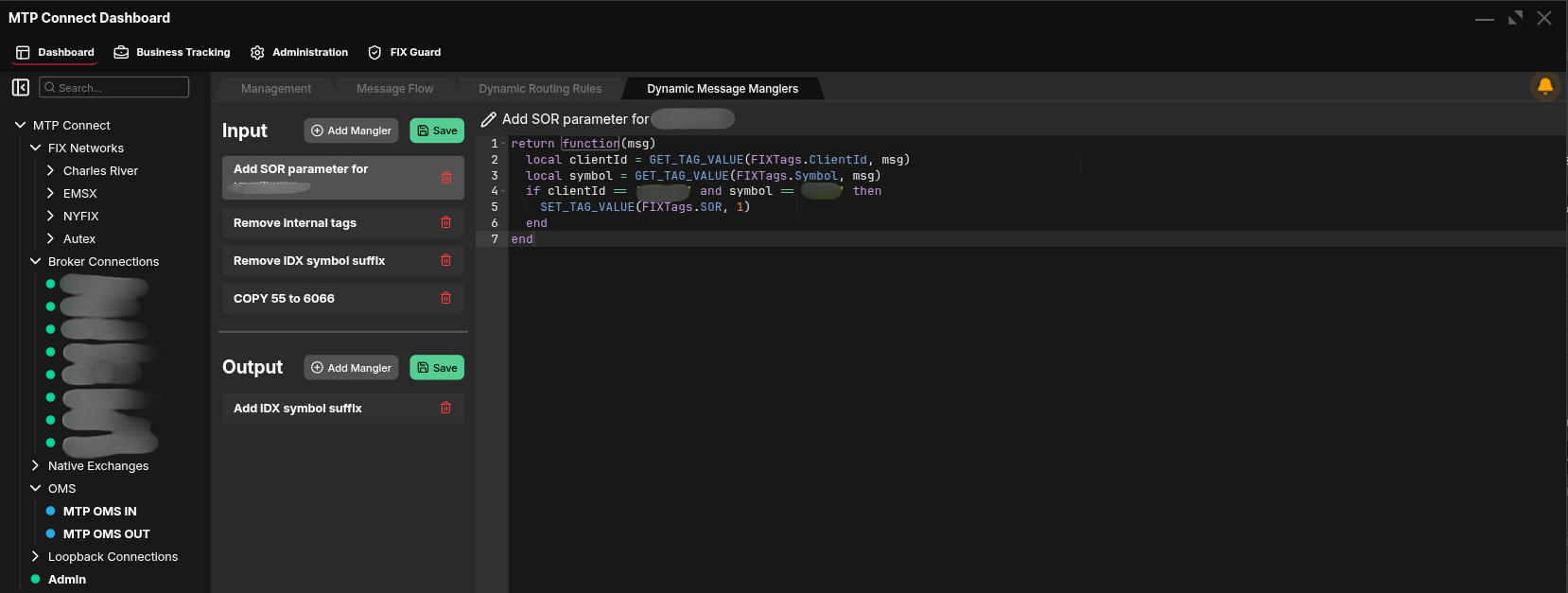
“We knew from day one that a ‘one-size-fits-all’ approach to connectivity was a non-starter. Every client’s infrastructure is a unique ecosystem, so our core design philosophy for MTP Connect had to be extreme adaptability. That’s why we built it around Lua; a simple, fast, and incredibly flexible scripting language that allows the platform to be molded to fit any environment, no matter how complex.
We drew inspiration from proven, battle-hardened architectures like the Linux networking stack. This allows us to implement sophisticated routing rules and message mangling right at the core of the engine, giving our clients granular control over their order flow.
But for me, the real game-changer is how we handle change. MTP Connect has its own built-in testing framework. You can mock the rest of the world and confidently prove that your new configuration works exactly as intended before it ever touches the live environment. It removes the stress and risk from a process that is traditionally fraught with both.”
Our Connectivity Solution: More Than a Hub, It’s an Engine
The solution that powers these use cases is MTP Connect, our “algo-powered low-latency precision routing and automation connectivity platform.” It acts as the central backbone for all communication, providing capabilities that solve the core challenges of a disconnected infrastructure:
- Extreme Low Latency: It is engineered for performance, capable of processing messages in less than 50 microseconds and handling hundreds of connections with millions of concurrent messages.
- Intelligent, Dynamic Routing: It moves beyond simple, static routing. It provides both rule-based and user-defined, code-based routing, giving you complete control over your order flow.
- Embedded Algorithmic Power: With a built-in, configurable algo engine and the ability to handle FIX message conversion and enrichment, it directly enables Sophisticated DMA (SDMA) and Direct Strategy Access (DSA) flows without needing extra systems.
Measuring Success: Analytics for Infrastructure Performance
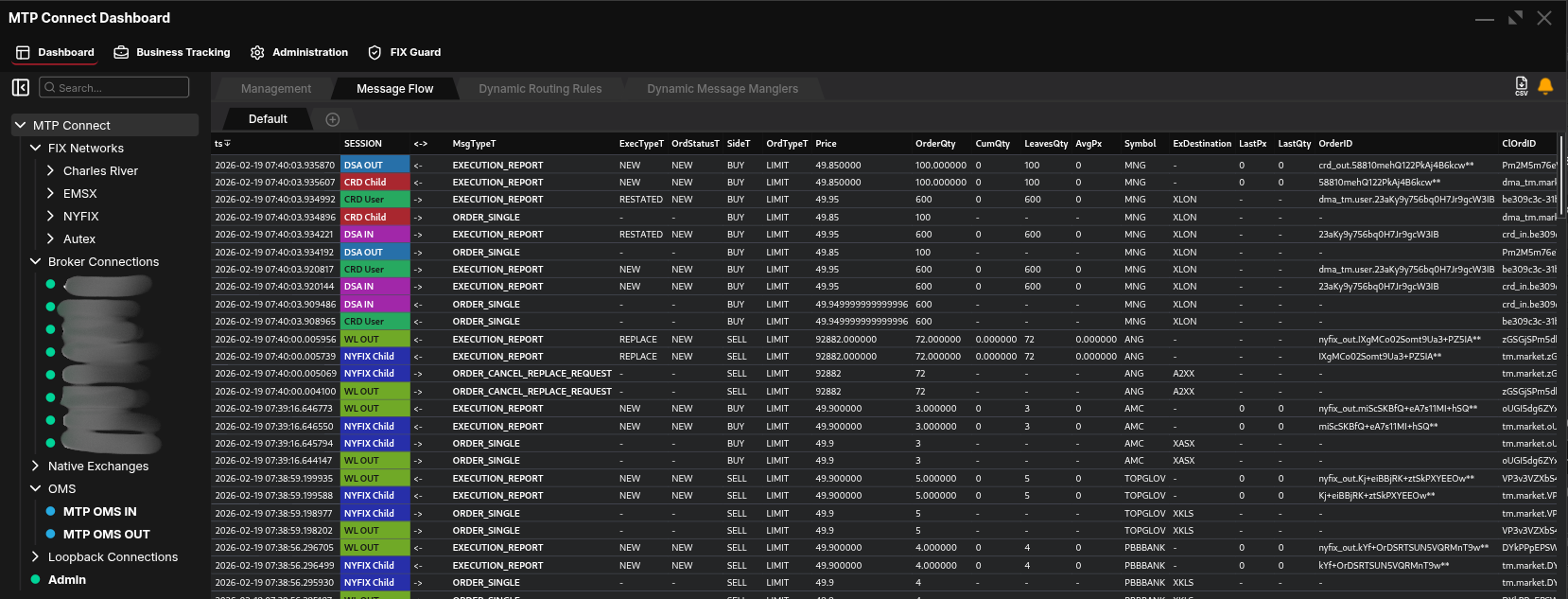
The success of a connectivity platform is measured by its direct impact on your operational efficiency, cost, and resilience. A platform like MTP Connect provides analytics and logs to prove the value delivered in each use case.
- For the Cost-Effective Smart Order Routing Use Case: Success is measured by direct Cost Savings on Commissions. Using the platform’s logs, you can analyze routing decisions and compare the cost of executed trades against what they would have cost on a more expensive broker. This allows you to report, “Automated routing saved the firm an estimated $XX,XXX in commissions last quarter by intelligently distributing trades based on size.”
- For the Rapid Market Expansion Use Case: The primary metric is Time-to-Market. Your project timeline becomes the key success story. You can definitively report, “We established a live connection to the new exchange and execution brokers in 5 days,” a task that would have previously taken over 6 months.
- For the Slashing Infrastructure Costs Use Case: Success is measured by Total Cost of Ownership (TCO) Reduction. By comparing infrastructure bills before and after consolidation, you can present a clear percentage or dollar amount saved on data lines, co-location, and vendor management. The platform dashboard proves this by showing all traffic is now flowing through a single, efficient point.
- For the Zero-Downtime Trading Use Case: Your key metric is the number of Automated Failover Events logged by the platform. An analytics report showing “3 provider outages handled last quarter with zero trading downtime” is the ultimate proof of a resilient and reliable infrastructure.
Conclusion
Ultimately, a modern connectivity platform isn’t just about connecting systems; it’s about unlocking potential. It transforms your infrastructure from a complex and costly liability into a strategic asset that delivers agility, resilience, and a significant competitive edge.
By centralizing not just your connections but also the intelligence that governs them, you empower your entire trading operation to perform at its peak.
Ready to see how a centralized connectivity platform can revolutionize your trading infrastructure? Contact us to request a personalized demo of our connectivity hub.